Page1 Page2 Page3 Page4 Page5 Page6
About CCENT certification: CCENT - Cisco Certified Entry Networking Technician is an entry level Cisco certification. Getting CCENT certified ensures that the candidate has enough knowledge to plan, configure, and operate simple WAN and switched LAN networks using Cisco products. No pre-qualification is necessary to take CCENT exam. 640-822 is the only exam necessary to pass for obtaining CCENT certification. 640-822 is required for achieving CCNA, which covers medium size enterprise branch networks with more complex connections.
1. The 7 layers of OSI model are :
The Application Layer: Application layer is responsible for identifying and establishing the availability of desired communication partner and verifying sufficient resources exist for communication. Some of the important application layer protocols are: WWW, SMTP, FTP, etc.
The Presentation Layer: This layer is responsible for presenting the data in standard formats. This layer is responsible for data compression, decompression, encryption, and decryption. Some Presentation Layer standards are: JPEG, MPEG, MIDI, PICT, Quick Time, TIFF.
The Session Layer: Session Layer is responsible for co-ordinating communication between systems/nodes.The following are some of the session layer protocols and interfaces: a) Network File System (NFS), SQL, RPC (Remote Procedure Call), X-Windows, ASP, DNA SCP.
The Transport Layer: The Transport Layer is responsible for multiplexing upper-layer applications, session establishment, and tearing-down of virtual circuits. This layer is responsible for flow control, to maintain data integrity.
The Network Layer: There can be several paths to send a packet from a given source to a destination. The primary responsibility of Network layer is to send packets from the source network to the destination network using a pre-determined routing methods. Routers work at Network layer.
The Data Link Layer:Data Link Layer is layer 2 of OSI reference model. This layer is divided into two sub-layers:
Logical Link Control (LLC) sub-layer: The LLC sub-layer handles error control, flow control, framing, and MAC sub-layer addressing.
Media Access Control (MAC) sub-layer:The MAC sub-layer is the lower of the two sub-layers of the Data Link layer. MAC sub-layer handles access to shared media, such a Token passing or Ethernet.
Physical Layer: The actual flow of signals take place through Physical layer. At Physical layer, the interface between the DTE and DCE is determined. The following are some of the standard interfaces are defined at Physical layer: EIA/TIA-232, EIA/TIA-449,V.24,V.35,X.21,G.703,HSSI (High Speed Serial Interface).
2. By implementing VLANs,
The effective broadcast traffic decreases, since VLANs do not forward the broadcast traffic from one VLAN to another.
The security can be improved by implementing a router (A layer 3 device) to route the packets among VLANs.
3. HTTP is the protocol used for accessing the World Wide Web services. HTTP operates over TCP/IP. TCP/IP is the protocol, which is used by all internet applications such as WWW, FTP, Telnet etc. IPX/SPX is proprietary protocol stack of Novell NetWare.
4. To verify vtp configuration on a Cisco switch, "show vtp" privileged executive command can be used. This command displays, among other things, VTP domain name, VTP password if any, VTP pruning mode (enabled or disabled) and the IP address of the device that last modified the configuration.
5. WANS are connected over serial lines and typically operate at lower speeds than LANs, and more expensive. Some of the WAN terms are:
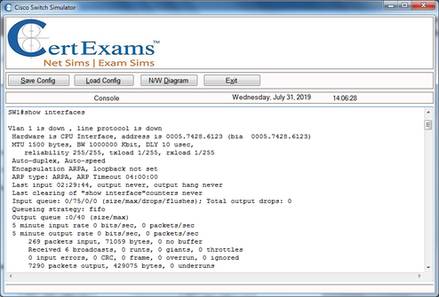
6. "sh int <interface_no> " is a very usefull command. It displays the following information:
7. If a properly configured workstation is unable to access the network information, it is likely that the DHCP information available with the client workstation had become obsolete. Issuing ipconfig command with /release and /renew commands will enable the client workstation to obtain latest changes to the DHCP server.
8. Some Important Cable Types Used Frequently:
9. Few Important things to note about OSI layer functions:
10. 100BaseT (Fast Ethernet) uses IEEE803.2u standard which incorporates CSMA/CD protocol.
11. 10Base2, and 10Base5 use coaxial cable for transmission of digital signals. Therefore, it can’t support simultaneous transmission and reception. On the other hand, 10BaseT and 100BaseT use RJ-45 connectors and Cat 3/4/5 cables. These cables have multiple pairs of wires, and hence support full duplex transmission (Note that the other parts of the network should also support full duplex, like the network card).
12. Consider a host IP156.16.3.47: The available hosts with a 11 bit subnet mask, may be computed as below:
11 bit subnet mask is equivalent to 255.255.255.224; It will accommodate 2,046 subnets, each with 30 hosts. The host address of 156.16.3.47 is in the 32 subnet range. The valid hosts for subnet 32 are 33-62. The broadcast address is 63.
13. To find the subnet that a host 56.16.3.52 with 12-bit subnet mask belongs to:
A 12-bit subnet mask gives us 255.255.255.240; 4094 subnets, each
with 14 hosts. (Host addresses of all zeros and all 1s can't be assigned).
The 156.16.3.52 is in the 48 subnet range. The valid range is through
49 - 62. 63 is a broadcast address.
Here is how you get the subnet
range:
1. Find the subnet mask. In this case, default subnet mask
for Class B address is 255.255.0.0. There are additional; 12 bits in
the subnet mask. Now the subnet mask looks like:
11111111.11111111.11111111.11110000.
This is equal to 255.255.255.240.0.
2. Now, deduct the lowest value
octet (Which is non zero), from 256. Here, (256-240)=16.
This is
the value that the subnets are incremented. Therefore, you will have
hosts with values from:.
156.16.3.1 to 156.16.3.14 (All 0s and all
1s host addresses can not be used)
156.16.3.17 to 156.16.3.30
156.16.3.33 to 156.16.3.46
156.16.3.49 to 156.16.3.62 and so on.
It is important to know that subnets are incrementing by a factor of
16.
14. 127.0.0.1 is the local loopback address defined by the Internet Protocol
and used for by a host to ping itself to verify the IP connectivity.
15. Important Layer 2 LAN protocols types:
Note that 802.3, and 802.5 are examples of layer 2 LAN protocols, whereas, HDLC, PPP are examples of layer 2 WAN protocols.


Cert-Ex™ Exam Simulators, Cert-Ex™ Network Simulator, Cert-Ex™ Cheatsheets are written independently by CertExams.com and not affiliated or authorized by respective certification providers. Cert-Ex™ is a trade mark of CertExams.com or entity representing Certexams.com.CCENT® is a trademark of Cisco™ systems.